
PHOTO
Long before its familiar steeple rose above Young, St Mary's Catholic Church began with something far more modest — a bark-roofed chapel built by gold miners during the early days of Lambing Flat.
Now, 150 years after the stone church opened on November 5, 1876, St Mary's remains one of Young's most recognisable landmarks, its history closely tied to that of the town.
The story began in late 1860 or early 1861, when Catholic miners joined a working bee to build a temporary wooden chapel near the present-day flour mill.
Known as the Bark Chapel, it was the first church established at Lambing Flat and also served as a school.
By 1862, schoolmistress Mrs Callan was teaching 49 pupils there.
As the settlement grew, a weatherboard church and school opened on the present St Mary's site on October 11, 1863.
Young became a separate Catholic parish in 1871, with Fr H. Finnegan appointed parish priest.
Just three years later, work began on a building that would transform the town's landscape.
On December 6, 1874, Bishop William Lanigan blessed the foundation stone of the new St Mary's before a gathering of about 800 people.
Designed by Italian immigrant architect Andrea Stombuco, the church was built in the shape of a cross, with Gothic-style pointed windows, elaborate stonework and a prominent tower. It was an ambitious undertaking for a growing country town.
J.P. Leeder supervised construction, assisted by skilled tradesmen, while John Murphy of Dublin was commissioned in December 1875 to cast the church bell.
On November 5, 1876, Bishop Lanigan officially blessed and opened St Mary's.
But the building that welcomed its first congregation looked quite different from the church standing today.
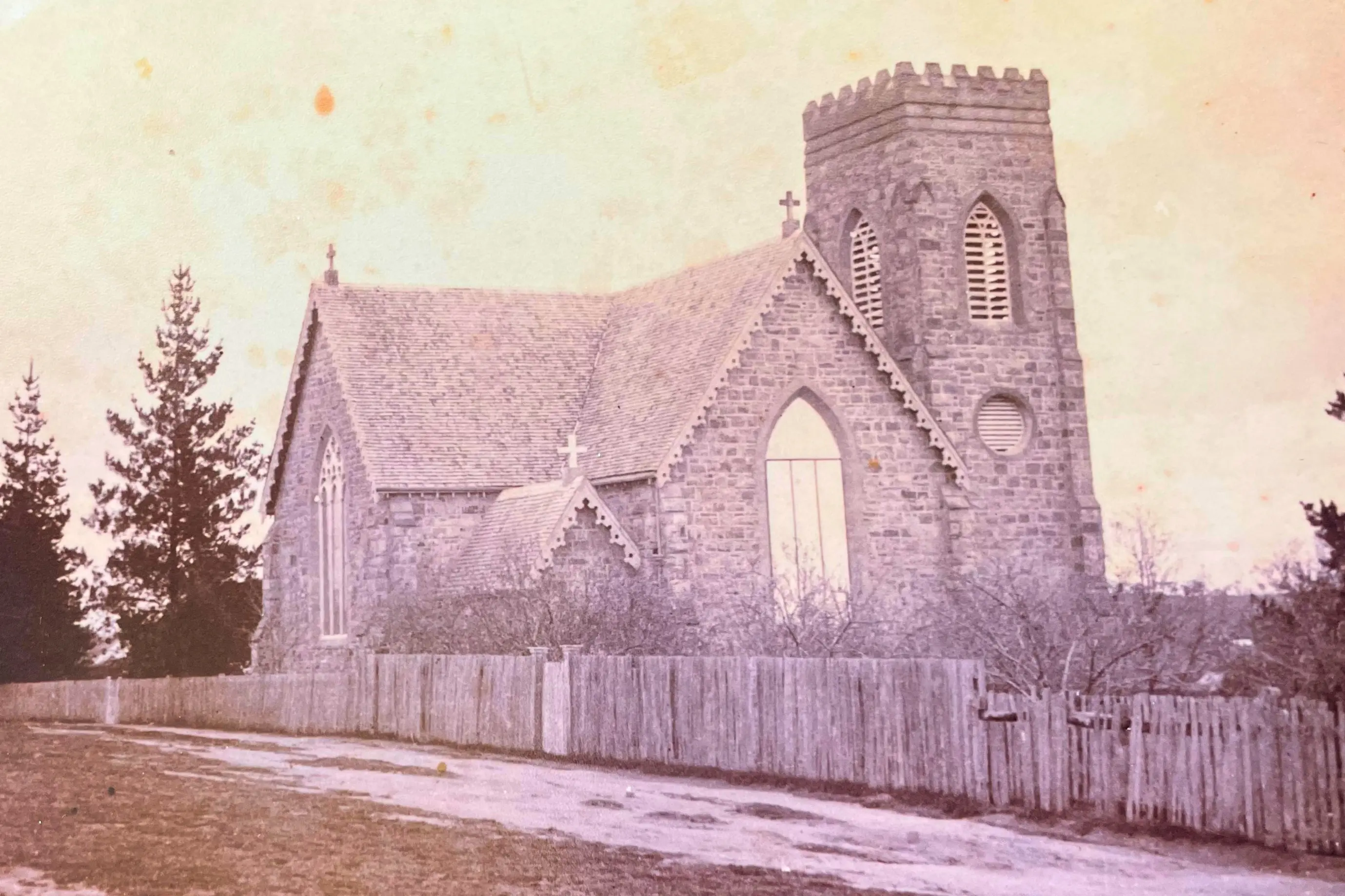
Historical photographs show the original square stone tower without the pointed steeple now familiar across Young.
As the parish grew, the building expanded. In 1907, a foundation stone was laid for major alterations, including extending the main body of the church, relocating the sanctuary and adding rooms. The work was completed within 12 months, with stonework designed to match the original building.
In 1931, the tower was altered and the steeple added to commemorate the golden jubilee of Monsignor Jerome Hennessy's ordination.
Further renovations followed in the 1950s, with interior changes in 1963 and 1986.
The church underwent another renovation in 2025, during the tenure of Fr Jiss.
Parishioners donated funds towards the work, which was overseen by Don Smith.
The improvements included interior painting and new carpet.
Inside St Mary's, the stained-glass windows tell another part of the story, depicting religious scenes while preserving the memories of local families.
Among those commemorated are the Myers family of Tyagong, the Dwyer family of Moppity and the Norton family of Marengo, along with the Baker, Tunney and Woodbridge families.
The tradition continued in 2001 with a window honouring the Mullany family, including local identities Dr Michael and Bernie Mullany.
One particularly distinctive window, designed by Fr Richard Thompson in 1986, depicts Jesus as the Good Shepherd surrounded by sheep deliberately modelled on the merinos familiar to the Young district.
These windows are not simply decoration, they preserve stories of families whose ties to St Mary's stretch across generations.
One of the church's most influential figures was Monsignor Jerome Hennessy, who arrived in Young in 1889.
Remembered as a priest, builder and philanthropist, he played an important role in developing the parish and services for the wider town. His years in Young saw growth in Catholic education and institutions, including schools, convents and the Sacred Heart Hospital.
The Presentation Sisters had arrived in 1886, beginning their own lasting contribution to education in Young.
Monsignor Hennessy died in 1941 and was buried beside St Mary's, the church with which his name remains closely associated.
His story is among those recorded in a parish history compiled by Chris Worthington, which is being updated for the 150th anniversary.
Yet the history of St Mary's is not solely a story of buildings and prominent names.
Parish historian Fr Allen Crowe said the church had long been an important focal point for the wider community, not just Catholic parishioners.
"I think it's been a stabilising building for people to gather," he said.
Fr Allen said the church's distinctive architecture had also contributed to its place in Young's identity, with its prominent tower and almost cathedral-like appearance setting it apart from many country churches.
For generations of local families, St Mary's has been the setting for weddings, baptisms, funerals, school occasions and community gatherings.
Old photographs show timber fences, unsealed streets and modest buildings surrounding the stone church.
Those streets and buildings have changed, as has St Mary's itself, but its place in the town has endured.
That connection between past and present will be celebrated over nine days from 31 October 31 to 8 November, with special masses, prayers, displays and community gatherings.
On the anniversary itself, 5 November, schoolchildren are expected to ring the church bell 150 times.
From a humble chapel built by miners to a landmark known across Young, St Mary's 150-year journey is also a chapter in the town's own story.