
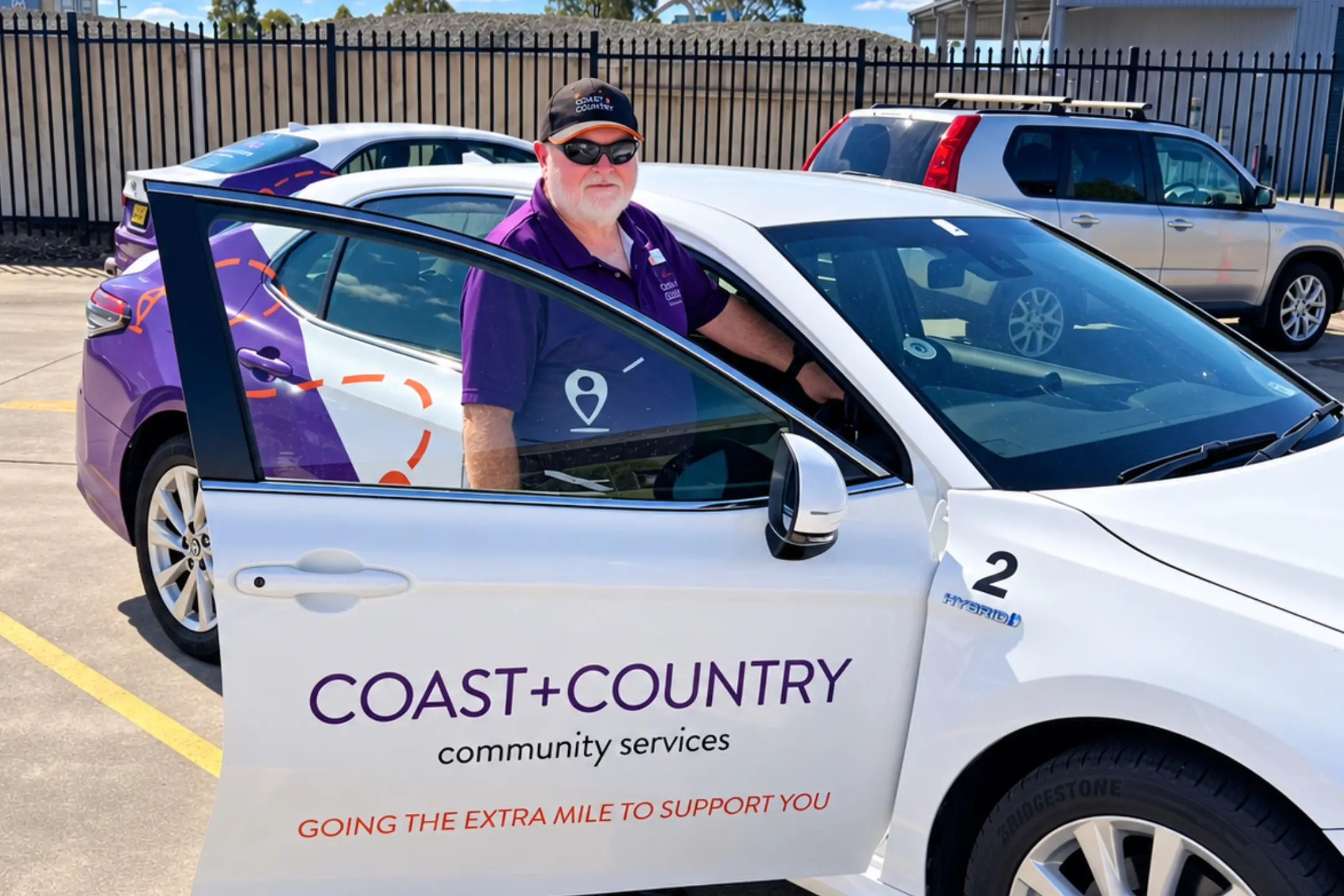
PHOTO
For many people across the Hilltops, getting to a medical appointment, hospital or other essential service can depend on community transport and the volunteers behind the wheel.
Those volunteers are not simply handed the keys.
Coast & Country Community Services provides training and ongoing support designed to help volunteers transport passengers safely and confidently, while also helping new volunteers learn the role.
For clients and families, that can provide reassurance. For people considering volunteering, it also shows they will be supported along the way.
CCCS has long-standing links to the Hilltops, with Young Community Transport forming part of the organisation when it was established in 2014 and Boorowa Community Transport joining two years later.
Today its community transport services help people travel for medical appointments, shopping, social outings and other services, including trips to larger centres where public transport options can be limited.
In the South West region, volunteer driver Clyde Kennedy joined CCCS earlier this year and has recently completed his driver training.
He now drives the Canberra shuttle and has also taken clients on social outings, helping people access medical appointments, hospitals and other services.
For Clyde, one of the attractions of volunteering is the opportunity to connect with people in the community while providing practical support.
While Clyde represents the beginning of the volunteer journey, long-term volunteer driver David Lockwood shows that learning continues well beyond the initial training.
David began volunteering with CCCS in Nowra in September 2021 and became a fully qualified volunteer driver on November 9 that year.
The day was memorable for another reason. That same morning, his youngest daughter called to tell him he had become a great-grandfather.
Almost five years later, David remains an active volunteer driver and also serves on CCCS's Work Health and Safety Committee.
Over that time, he has completed training in areas including First Nations cultural awareness, manual handling, driver safety and workplace health and safety.
Some of the lessons are simple, but can make a direct difference to passenger safety.
One involves where passengers place their walking sticks while travelling. David said passengers can sometimes position a walking stick between their legs without realising it could cause serious injury in an accident.
“One of the things we cover is clients putting their walking stick between their legs,” David said.
“I pick up clients now and tell them not to, and they say, ‘Oh, I hadn’t thought about that.’ Which is exactly what we all said when we were told.”
It is a practical example of how training can translate directly into safer travel for passengers.
David's involvement in the Work Health and Safety Committee gives him another way to contribute. The committee meets every three months to consider issues raised by drivers and other team members, changes to requirements and ways of sharing important safety information across the organisation.
Training for CCCS volunteers is delivered through a mix of practical instruction, face-to-face sessions and online learning, depending on the role and its requirements.
Volunteers who need assistance with online learning can access devices and support through CCCS offices, while the organisation also helps volunteers understand and complete requirements associated with their roles.
First aid training has also recently been arranged for team members in the South West region.
For an organisation that relies on volunteers to help people remain connected to services and their communities, that training and support plays two roles — helping protect the people using the service while giving volunteers the confidence to take on the responsibility.
For David, the value is straightforward.
“It just keeps us up to date with whatever’s changed, state, federal or within the organisation,” he said.
“It makes us more aware, and safer, on the road.”