
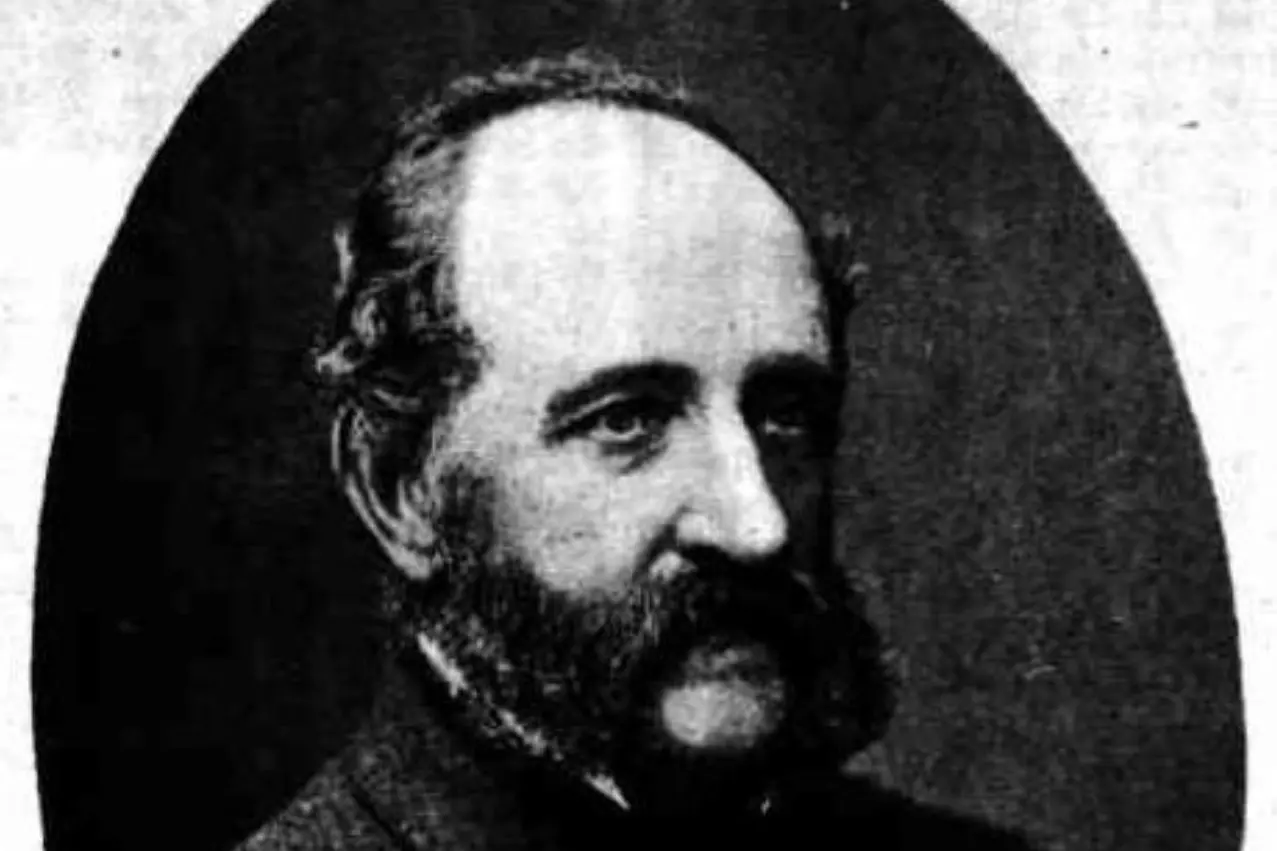
PHOTO
By KAREN SCHAMBERGER Karen – Young Historical Society
In the aftermath of the Lambing Flat riots of 1860-61, the NSW colonial government passed the 1862 Police Regulation Act to create a unified Police Force in order to more effectively deal with large scale rioting in the future. This legislation created the foundation for the NSW Police Force as it is today. The colony was divided into districts, under the command of a superintendent and sub-districts, under the command of an inspector and sub-inspectors.
Edward Montagu Battye was appointed as the first Inspector of Police at Young in February 1862 and it was hoped that his presence would ‘lead to the detection of those highway-men who have recently infested the country between Lambing Flat and the Lachlan.’ By March he was doing his best to stop the slaughter of cattle stolen from the Macquarie, Bogan and Lachlan districts on the Burrangong goldfield.
He also succeeded in apprehending two men, Smith and Butler, who had been involved in recent robberies, including that of the Bathurst mail. Later that month he apprehended three others, Downey, John Maley and Deely.
Downey had earlier stuck up Messers Horsington and Hewett who were on their way from Little Wombat to Burrangong (Young) and the other two were apprehended on suspicion of highway robbery.
Battye, though, needed more manpower to effectively deal with the bushrangers and he requested two Aboriginal trackers to assist.
The idea was excellent, because the great difficulty was to track these robbers in the bush. Unfortunately, his request was denied.
Battye was responsible for the arrest of Charles Robardy and Auguste Rivet for the murder of Daniel Crotty, the Marengo mailman in August 1862. He also captured a man by the name of Clarke, for the murder of Mr Cirkel at Stoney Creek in February 1863.
In early April 1863, however, the colonial government ordered Captain Battye to move to Braidwood to take the place of Inspector Wilshire and Inspector Singleton, recently promoted in rank, proceeded to Burrangong.
This shocked and disappointed the local population. A farewell dinner was arranged for him as a mark of esteem.
Battye had been born in March 1817 in Kensington, London and was educated at Wandaworth and Brighton.
His first commission was in the 18th Lancers and then in 1835, he joined the 23rd Royal Welsh Fusiliers, in which he rose to the rank of Captain.
In 1837 he sailed to Canada and after his marriage in 1840, he arrived in New South Wales. By 1851 the NSW colonial government employed him with a view to reorganising the entire police forces which were having trouble managing the chaos of the goldrush. He died on Tuesday 12 July 1898.