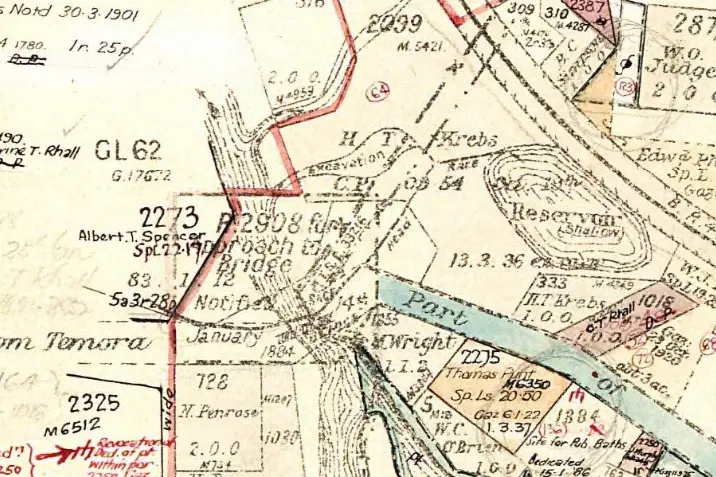
Nicholas Penrose married Ann Elliott at Durham, England in 1850. Their first son Nicholas was born at Durham in 1854. The family then sailed for Australia, settling in Victoria where their children’s births were registered: John in 1859, Harriet in 1861, Elizabeth in 1862 and William in 1864 but he died at Young in 1865. The Penrose family took up a sluicing claim between Chance Gully and Opossum Flat on the northern side of Burrangong Creek in July 1865. Nicholas worked this claim with his brother-in-law, creating a dam, water races and a bridge across Burrangong Creek by 1868. The couple’s youngest son, Robert was born at Young in 1869. In December 1873, Nicholas purchased two acres (portion 728) which is located on the eastern side of to what is now Krebs Road, and west of the junction of Burrangong Creek and Spring Creek. In January 1878, he purchased one acre, three roods and 27 perches (portion 1080), which extended his land east, almost to Spring Creek and a little further south. By 6 February the bridge crossing the Burrangong Creek connecting the Old Temora Road with the current Temora Road was called Penrose Bridge. Nicholas and his family mined the area in and around his property. "Water was obtained for sluicing purposes which for years afterwards was known as Penrose's Dam, situated just behind the residence. Water was secured from Burrangong Creek by means of a water race which had its origin just above Lynch Street Bridge. Rich gold was recovered between Penrose’s Bridge and the railway line. When this was worked out, sluicing operations were engaged in near Temora Road, where several acres were treated with good results.’ Nicholas senior, was also one of the earliest church wardens of the Church of England in the town and took an interest in the Pastoral and Agricultural Association, Hospital, Turf Club before his death in August 1894. Nicholas’ widow, Ann, died in November 1912, by which time Penrose’s Dam carried a field of wheat or oats and Penrose’s race was partially filled, having been taken under the control of the local council. Nicholas’s eldest son, Nicholas junior, had joined his father in mining pursuits before following the occupation of builder, constructing many homes around the district, including those of pisé. He had married Fanny Sneddon in 1876. In 1914 he sold the family property to William John Myers whose wife Phoebe then ran the Excelsior Laundry on this site and where they also continued sluicing with the cradle displayed at the Young Historical Museum. Nicholas junior died in July 1918.