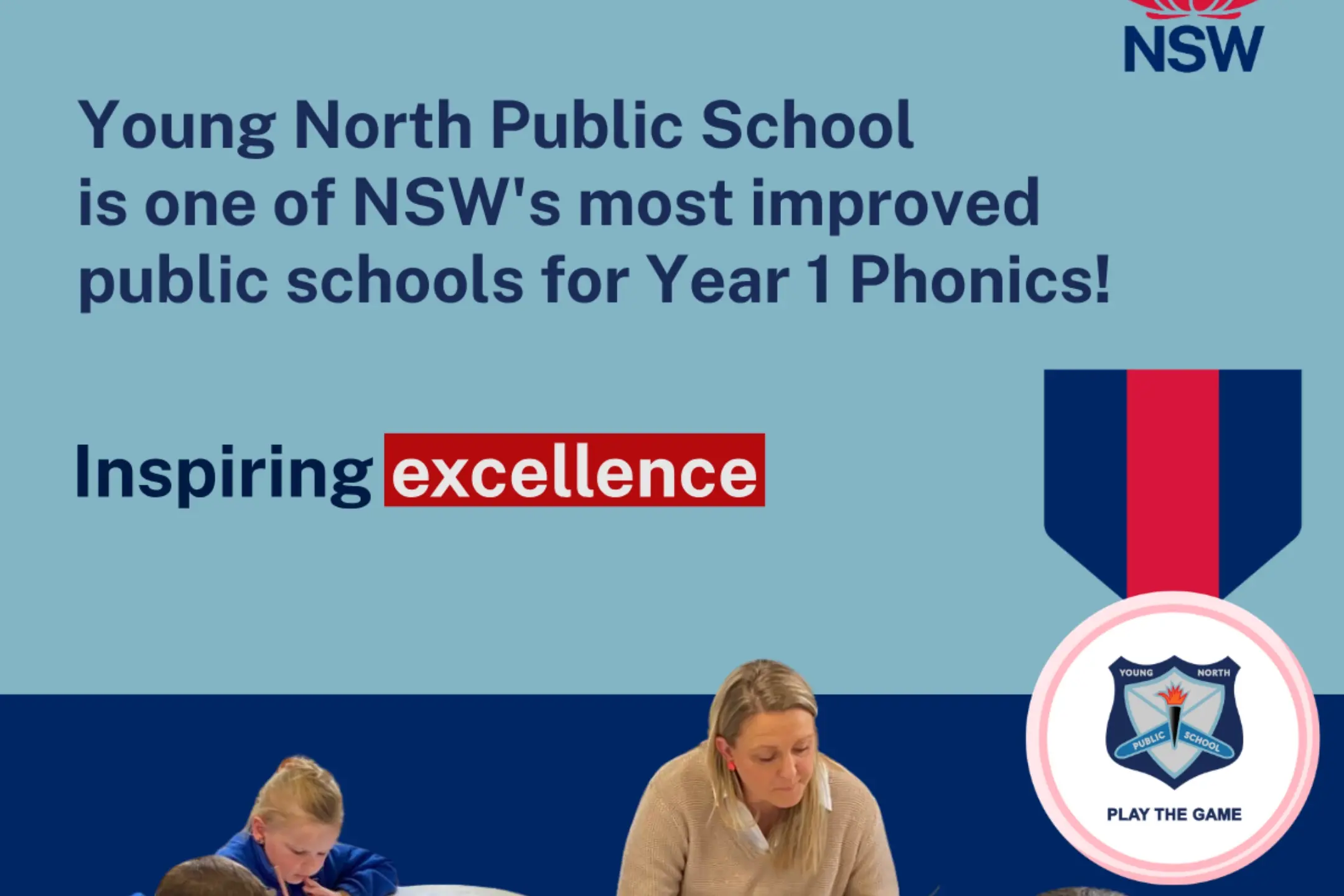
Young North Public School has been recognised as one of the most improved schools in NSW for phonics after several years of deliberately changing and strengthening the way reading is taught.

The school was congratulated by NSW Deputy Premier and Minister for Education and Early Learning Prue Car and Department of Education Secretary Murat Dizdar for its consistent improvement in Year 1 Phonics Screening Check results between 2022 and 2025.

Young North Assistant Principal of Curriculum and Instruction Gillian Cusack said the improvement had not come from one program or a single change.

Instead, she said it reflected a sustained whole-school focus on explicit teaching.

For parents who may be unfamiliar with the term, explicit teaching means children are not expected to simply pick up reading skills along the way.

Teachers introduce skills directly and in a planned order, demonstrate them clearly, give students plenty of opportunities to practise and regularly check that children understand before moving on.

“At Young North, reading is taught in a very deliberate, sequential way — phonics skills are introduced systematically, built on step by step, and revisited often so nothing is left to chance,” Mrs Cusack said.

Phonics teaches children the relationship between letters and the sounds they represent, helping them work out unfamiliar words when learning to read.

Young North has adopted explicit teaching across the school, with teachers using structured literacy programs including InitiaLit, MiniLit and MacqLit to teach reading skills in a consistent and systematic way.

The programs provide different levels of reading instruction and support, allowing students to receive more targeted help when needed.

Mrs Cusack said an important part of the improvement had been ensuring students experienced a consistent approach regardless of their classroom or teacher.

“We’ve worked hard on consistency — making sure every classroom uses the same low-variance routines, so students experience the same high-quality instruction regardless of which room they’re in,” she said.

“That consistency, built up year on year, is what I believe underpins the improvement in our phonics data.”

Teachers model new skills, regularly check students’ understanding and provide repeated opportunities for practice.

Mrs Cusack said the school also places strong emphasis on academic vocabulary and helping students develop what it calls a “public voice” — the confidence and language to explain their thinking aloud.

“It’s a very structured, purposeful approach, but one that is also warm and responsive to where each child is at,” she said.

The recognition comes as more than 60 NSW public schools are being commended for improvement or high achievement in phonics.

Around two-thirds of those schools recorded an improvement of at least 30 percentage points since 2022, while statewide the proportion of Year 1 students meeting the foundational literacy benchmark increased by nine percentage points between 2022 and 2025.

The NSW Government has placed a stronger emphasis on explicit phonics instruction, screening students in Year 1 and providing additional small-group tuition for children requiring extra support.

Mrs Cusack said Young North’s result reflected the combined efforts of teachers, students and families over several years.

“Improving phonics results consistently between 2022 and 2025 takes real dedication from teachers who have embraced new ways of teaching and committed to doing the small things well, day after day,” she said.

“I’m incredibly proud of our staff for their willingness to be coached, to reflect on their practice, and to hold high expectations for every child.”

She said students deserved recognition for their effort, while families had played an important role by supporting reading habits at home.

“Above all, I’m proud that this has been a genuine whole-school effort,” Mrs Cusack said.

“It reflects a shared belief that every child at Young North can and will learn to read well.”