
PHOTO
74797.0
By KAREN SCHAMBERGER – Young Historical Society
John Rogan was born at Castle Hill on 9 June 1839 to John Rogan and his wife Charlotte née Bellamy.
His wife Mary Jane was born to Joseph and Catherine Limond in 1843. John and Mary married at Picton in 1860. They had five children before moving to Young in early 1872. John started a Blacksmithing and Coachbuilding business on Boorowa St.
In August 1872, he won second prize for a wooden one-wheel plough and harrows which was entered into the Agricultural Implements class of the second Burrangong Pastoral and Agricultural Association Show.
On 13 June 1872, the NSW Government advertised for tenders for the erection of a new court-house at Young. The old court-house, which had been built at Camp Hill in 1862 after the first one had been burnt down during the 14 July 1861 riot, was in a dilapidated and dangerous state.
By 1873, a new court-house in Lynch St was constructed. According to Rogan’s daughter Mary Jean Whalen, John had bought the old court-house building and renovated and re-erected it on his land at McLerie St where it still stands today.
The front veranda was formerly the ‘dock’, and there were four rooms in the house where nine of his children were born.
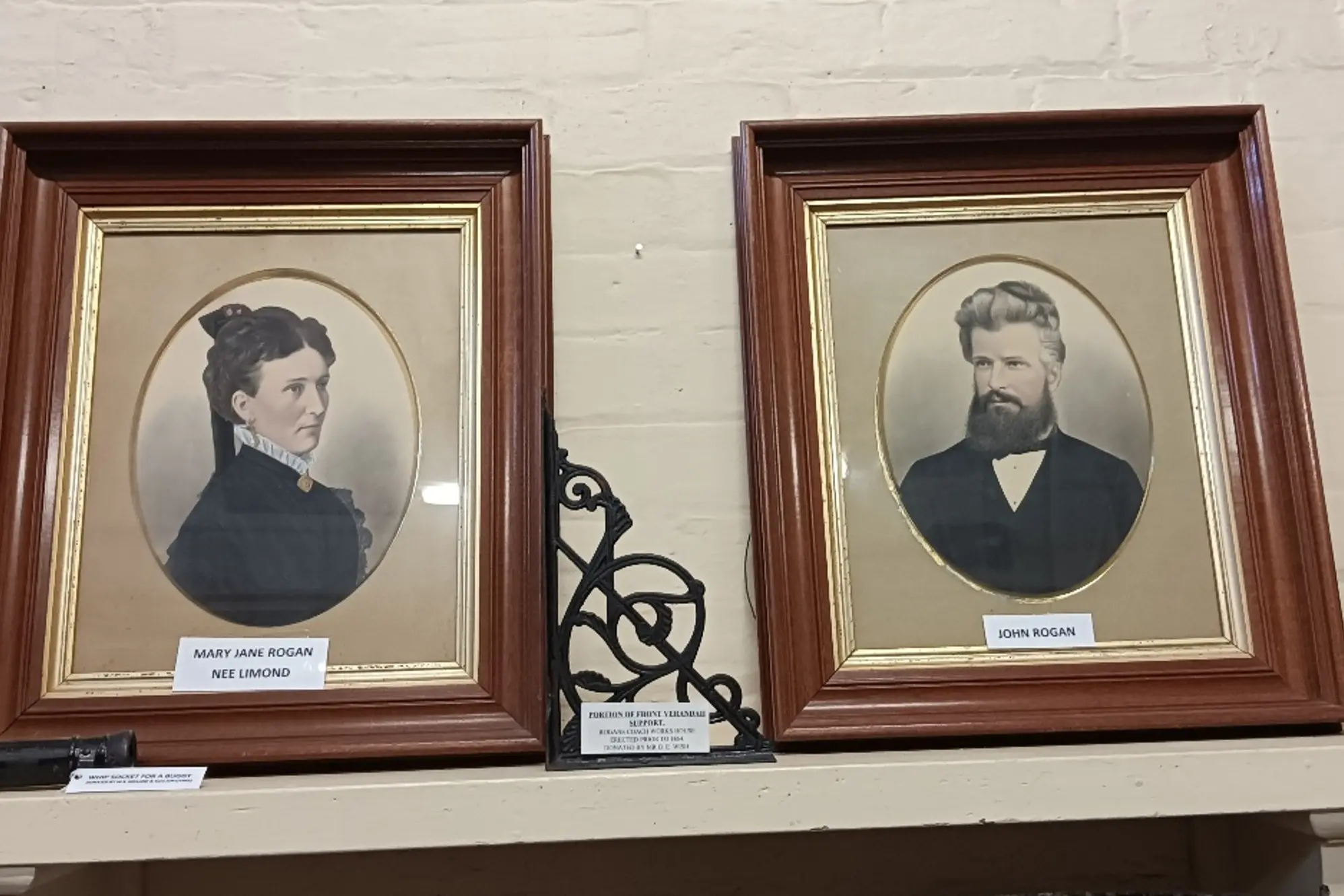
In the 1960s, George Whish donated a portion of a veranda support from this house which is now displayed at the Young Historical Museum along with photographs of John and his wife Mary Jane.
In 1874, John moved his business to Lynch Street where the railway gates are. In June 1875, he entered into a partnership with George Lancashire and they took over the buggy building business of Phillips & Co on the corner of Boorowa and Lynch Streets.
In 1876, George became the sole operator of that business and John moved his business to Lovell Street until the government requisitioned the land for the railway. In 1885 he built a brick shop on the corner of Boorowa and Zouch Streets, remaining there until he retired in 1899.
In February 1885, John was elected as an Alderman to the Young Borough Council and was then elected Mayor in February 1886, serving in that role for a year.
He held a financial interest in the new Court House built on Campbell St by the contractor Gough & Co. It opened on 6 April 1886. John then served as an Alderman until 1894.
He was also a guarantor of St Mary’s Church and a member of the building committee for the church and school. Mary died shortly after they celebrated their Diamond Wedding anniversary in July 1920, dying on 20 October. John died on 2 October 1921.