
PHOTO
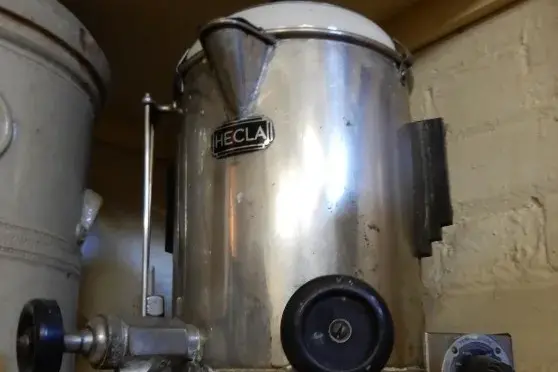
This Hecla electric urn with a ceramic interior was found at the Bribbaree Memorial Hall.
Clarence William Marriot formed and registered Hecla Electrics Pty Ltd in Melbourne in 1922 and the company quickly became Australia’s leading supplier of electric heating appliances, including kitchen appliances, hot water heaters, and commercial heating appliances for use in cafes, hospitals and offices.
I sent an enquiry to Museums Victoria who hold a collection of Hecla Electrics company materials to find out more about the urn from Bribbaree.
Comparisons with other Hecla urns in their collection and documents in the company archive suggested a possible date range of the 1930s to 40s.
This correlates with the lead up to the opening of the Bribbaree Memorial Hall on 17 August 1955.
The community of Bribbaree opened their first public hall on Sunday 1 December 1918.
According to Ruth and Noel Hanigan’s book ‘Centenary of Education in Bribbaree and District 1894-1994’, the Bribbaree-Maimuru branch of the Country Women’s Association formed in 1933 and amongst their objectives was to work on Community Projects.
Their meetings were held in homes and rented rooms.
After the war on 25 August 1945, the community of Bribbaree met to discuss the creation of a suitable Memorial to Returned and Fallen Personnel of World War II for the Bribbaree District, deciding to build a Memorial Hall.
In April 1946, a decision was made to include a CWA Rest Room in the Memorial Hall and by 14 June 1947 636/12/4 pounds had been raised.
A sports carnival was also held that year.
In 1948, a Junior Debutante Ball was held in the old hall.
By 1951, 864/11/2 pounds had been raised and a target of 6000 pounds was set.
Logs and timber which were cut at Alex Aston’s timber mill was then sold and the proceeds placed into the Fund for the Memorial Hall.
Then came the most successful fundraising push – the Popular Mothers Competition.
Mrs. K McCallum, Mrs Holland and Mrs Moran Sr were the lead organisers.
‘Woolsheds and private homes were commandeered, stretching from Moonbucca and Eurabba to Greenbank at Thuddungra. Garden parties, dances, competitions and parties etc. were organised.’
By the end of the campaign, at the ball night, 2000 pounds had been raised and Mrs K McCallum was declared the winner.
Fundraising functions continued and eventually the Memorial Hall was completed at a cost of 16,000 pounds.
It was furnished with a new complete electric Kitchen as well as many other modern amenities by the time it opened in 1955.
The old Hecla electric urn, was most likely then placed in storage before being donated to the Young Historical Museum in the 1980s.